
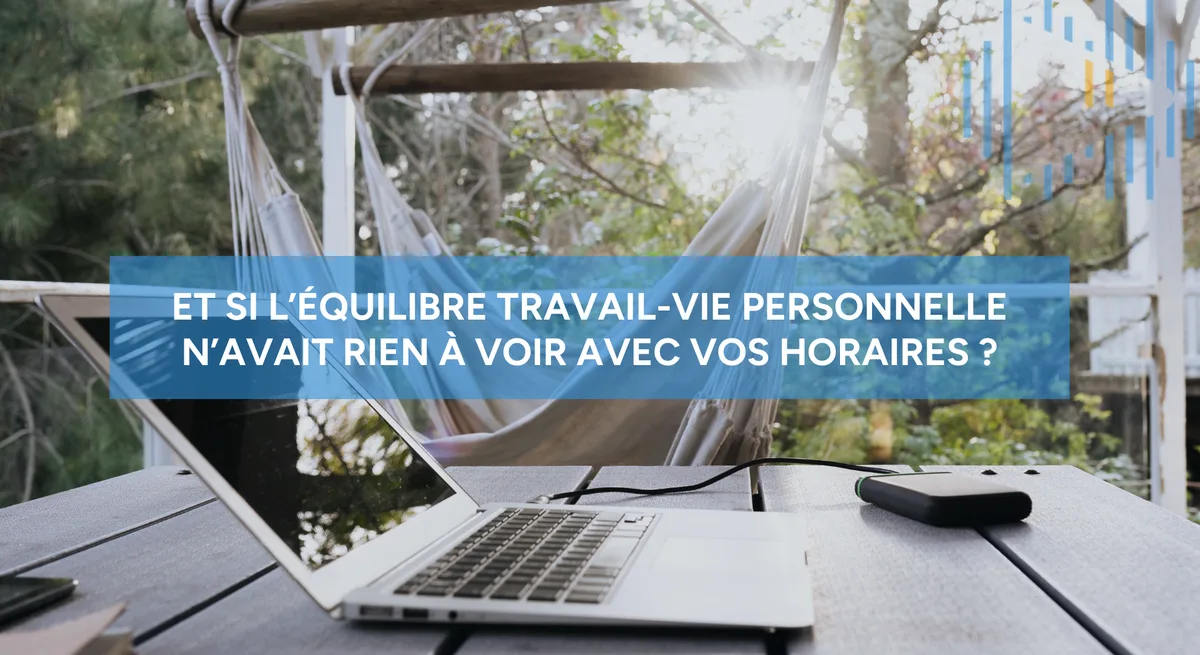
📉 85% of workers say they never really disconnect. Fixed hours or remote work do not guarantee balance. What matters is your energy, your mental load and your ability to stop.
The line between personal life and work is blurrier than ever. We can reach our email from anywhere, notifications pile up, and a culture of “always available” settles in. How do you avoid feeling under constant pressure and find a balance that lasts? Here are practical places to start.
1. Stop glorifying overload
❌ “I’m swamped!” is not a sign of success. Working to exhaustion is neither proof of competence nor a lasting strategy. An excessive workload only leads to less effectiveness and more stress.
💡 A concrete step: Cancel meetings that are not useful and ask a simple question: does this task add real value, or is there a more effective way to do it? Use the 2-minute rule: if a task can be done immediately in less than 2 minutes, do it. Otherwise, schedule it deliberately.
2. Rethink the link between effectiveness and time spent working
⏳ Working longer does not mean being more productive. Effectiveness depends on the quality of the work, not on the number of hours in front of a screen.
💡 Something to try: Experiment with periods of deep focus (for example, the Pomodoro method), followed by real breaks away from screens. Recovery matters as much as the work itself. Some organizations are even testing a 4-day week and seeing gains in productivity and employee well-being.
3. Repair the culture of the immediate reply
✉ Email at 10 p.m. damages your balance more than a full calendar. The implicit pressure to be available all the time feeds chronic stress that harms mental health.
💡 A simple idea: Set team rules. What are reasonable hours for a reply? Which subjects need an immediate response, and which can wait? A clear frame reduces collective pressure. Some organizations go further with email-free days or by turning off work messaging after a set hour.
4. Make non-work a priority
Real balance is not only about “working less.” It is about reconnecting with activities that restore mental and physical energy. A real break is not scrolling on your phone. It is an activity that lets your mind step away.
💡 An unexpected tip: Put your leisure time in your calendar. A family outing, a workout or time to read matters as much as a meeting. What is scheduled is more likely to happen. Some studies show that people who take active breaks are more creative and perform better.
5. Fit balance to your reality
A good balance changes with the season of your life. Some days you need flexibility, others you need structure. What matters is having room to manoeuvre.
💡 A question to keep: “Am I in control of my pace, or is it controlling me?” If you often feel controlled by it, it is time to adjust. Notice when you are most productive and organize your day around that.
🎯 Conclusion: fewer unreachable ideals, more realistic adjustments
Rather than treating work-life balance as a luxury, treat it as a practice you keep refining. The aim is not an unreachable ideal. It is simple habits that make daily life better.
👉 What is the first step you can take today?
← All articles